Customizable Color LED Roofline Lights: 2026 Guide
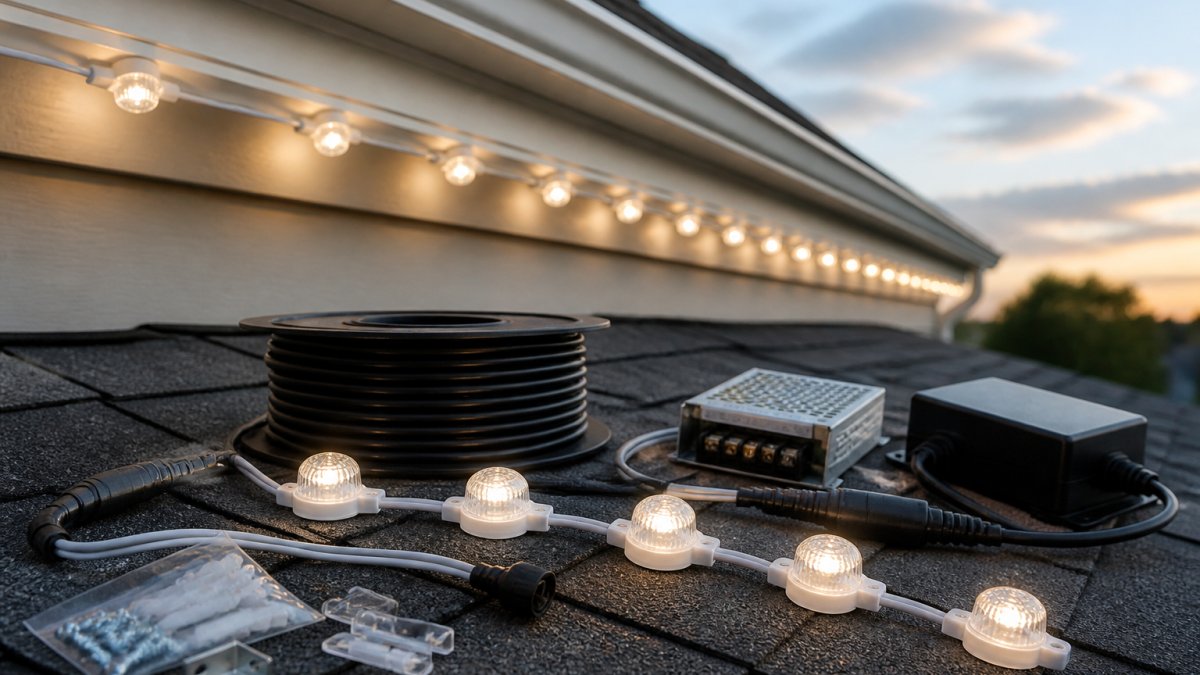
Compare customizable color LED roofline lights for 2026. Learn app control, color accuracy, durability, and what to check before you buy.
Table of Contents
- Why Customizable Color LED Roofline Lights Beat Seasonal Strings
- Permanent LED Roofline Lights: What Sets Them Apart
- App-Controlled Permanent Outdoor Lights: Control, Scheduling, and Privacy
- How to Set Custom Colors on LED Lights for Any Occasion
- Outdoor Roofline Lighting Ideas for Every Season
- Color Accuracy, Brightness, and Weather Resistance
- Installation, Ownership Costs, and Warranty Coverage
- Frequently Asked Questions
Last Updated: October 5, 2026
Why Customizable Color LED Roofline Lights Beat Seasonal Strings
Customizable color LED roofline lights are permanent, low-voltage LED systems mounted along your eaves that change color, brightness, and pattern through an app, replacing the annual climb-and-clip ritual of string lights.
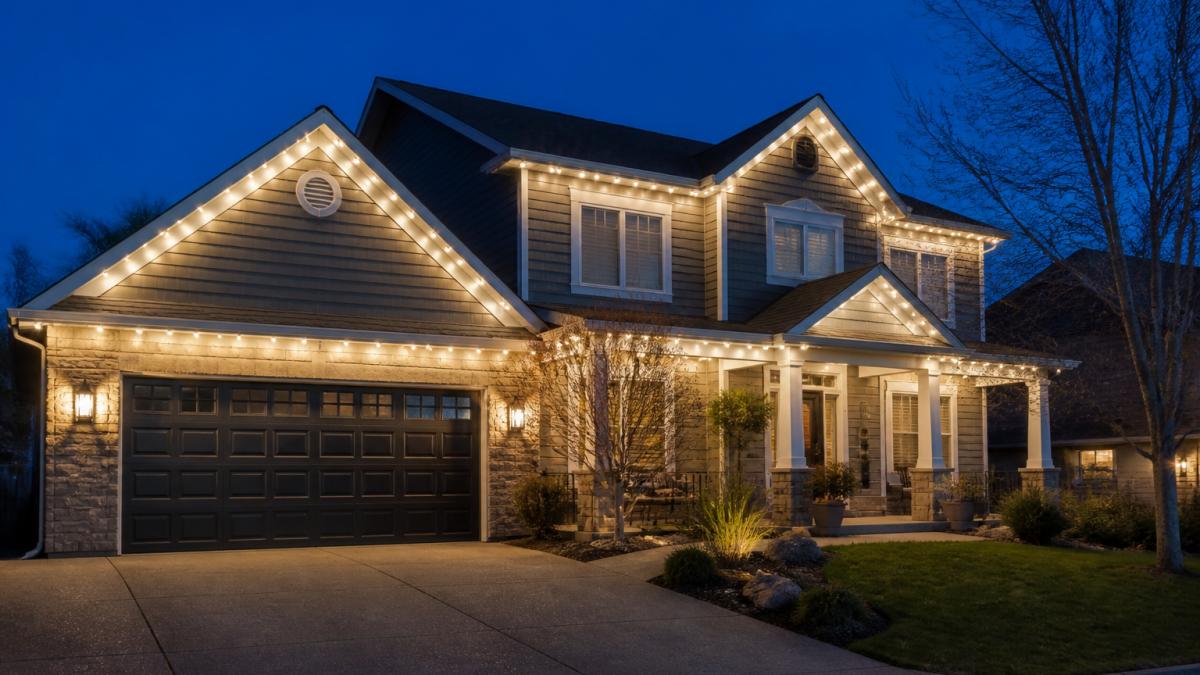
The old approach has a predictable failure point. Clip-on strings slip in wind, crack in deep cold, and leave you on a ladder every November.
That shift changes how you think about exterior lighting. Instead of buying, storing, and replacing strings each year, you own one system that adapts.
Permanent LED Roofline Lights: What Sets Them Apart
Permanent LED roofline lights are track-mounted or channel-mounted LED fixtures installed along the eaves and roofline, designed to stay up year-round and survive weather that destroys seasonal strings. The core difference is engineering: these systems use low-voltage LED components rated for outdoor exposure, with color-programmable control built in.
How Permanent Systems Differ From Clip-On Holiday Lights
Clip-on strings rely on plastic clips and thin wire. They work for a season, then fail.
Permanent systems use aluminum tracks or channels that hold each light in a fixed, even line. The lights sit in a protective housing, so snow, ice, and UV exposure don't degrade them the way they degrade exposed string wire. You get a clean, seamless appearance instead of sagging spans and visible cords.
What to Look for Before You Buy
A few specs separate a system that lasts from one that disappoints:
- Weather rating: Look for an IP67 waterproof rating, meaning the fixtures resist dust and survive temporary immersion. In practice, that rating is what carries a system through freeze-thaw cycles.
- Cold-weather performance: Confirm the LEDs are rated for sub-zero operation, not just "outdoor use."
- Custom-fit tracks: Color-matched tracks that blend into your fascia make the lights virtually invisible when off.
App-Controlled Permanent Outdoor Lights: Control, Scheduling, and Privacy
App-controlled permanent outdoor lights let you change colors, set scenes, and schedule your roofline from a phone, with no ladder involved. Most systems pair a smart app with optional remote control, and many integrate with common smart-home platforms.
Connectivity and Smart-Home Compatibility
Check how the system connects before buying. Some run on Wi-Fi directly; others use a hub or bridge. If you already run a smart-home setup, confirm compatibility so you're not juggling three apps.
The best systems offer a user-friendly interface that a non-technical household member can operate without a manual. If the app feels like a chore, the lights won't get used.
Scheduling, Automation, and Data Privacy
Scheduling is where permanent systems earn their keep. Set your roofline to switch on at dusk, run a holiday pattern through December, then return to warm white in January, all automatically.
Privacy deserves a mention most buyers overlook. A cloud-connected app may collect usage data. If that matters to you, look for a system that supports local control or clearly states what it collects.
How to Set Custom Colors on LED Lights for Any Occasion
Setting custom colors on LED lights takes three steps: open the app, pick a color or scene, and save it as a preset. Most apps use a color wheel or slider for RGB colors, plus preset programs for common looks.
Here's the practical sequence:
- Open the smart app and connect to your system
- Choose a single color from the wheel, or select a preset scene
- Adjust brightness and color temperature to taste
- Save the look as a named preset for quick recall
- Set a schedule so it activates automatically
The trick most people miss is saving presets. Rebuilding a color every time defeats the purpose. Name your presets by occasion, so "game night" or "holiday" is one tap away.
Outdoor Roofline Lighting Ideas for Every Season
Outdoor roofline lighting ideas work best when you plan around the calendar rather than one holiday. A permanent system lets you shift the mood without touching a wire.
- Winter holidays: Classic red and green, or warm white for an understated look
- New Year: Bright white or gold with a subtle chase pattern
- Spring: Soft pastels for Easter and the longer evenings
Year-round lighting means the system is used year-round, not stored. Seasonal lighting stops being a chore and becomes a setting you change from the couch.
Color Accuracy, Brightness, and Weather Resistance
Most buyers shop on color count, but the number that actually determines whether you'll like the system two years from now is white-light quality. A roofline spends most of its life in a single warm or cool white, not in a rainbow scene, so the white output is the spec that matters most.
What Actually Determines How the Lights Look
Four mechanisms drive perceived quality, and each one is worth asking about directly:
- LED binning and color consistency. LEDs are sorted (binned) by color output during manufacturing. Cheap systems mix bins, which is why one section of your roofline can look slightly greener or pinker than the next. Ask whether the manufacturer bins for consistency across a run.
- Color temperature (CCT) and white quality. Warm white typically sits around 2700K-3000K; cool white around 4000K-5000K. A system that only produces a harsh, blue-tinted white will look clinical against brick or stone. Ask for the CCT range and whether the white is a dedicated white LED channel or a mixed RGB approximation, dedicated white channels look noticeably cleaner.
- Color rendering (CRI). CRI describes how faithfully a light shows the true colors of surfaces it hits. For exterior lighting, higher CRI makes siding, stone, and landscaping look natural rather than washed out. Most residential roofline systems don't publish CRI.
How It Looks on Different Homes
The same system reads differently depending on what it's mounted to:
- Light siding (vinyl, white stucco): colored light reflects strongly and can wash out; warm white tends to look best.
- Dark siding or brick: colors read deeper and more saturated; brightness may need to be dialed up.
- Two-story facades: light spill and shadowing differ from single-story homes, so even output across a long run matters more.
Weather Resistance Beyond the Rating
IP67 is the baseline, it means the fixtures resist dust and survive temporary immersion. But IP67 alone doesn't tell you how a system handles a real winter. Look for:
- Operating temperature range that explicitly covers sub-zero conditions, not just "outdoor use."
- UV-resistant housing to prevent yellowing and cracking on south- and west-facing runs.
- Sealed connectors and strain relief at each junction, since water intrusion usually happens at connections, not in the fixtures themselves.
| Feature | What to Check | Why It Matters |
|---|---|---|
| White-light quality | Dedicated white channel, CCT range | Warm white should look warm, not blue |
| Color consistency | LED binning practice | Prevents mismatched sections |
| Brightness | Lumens and even output across the run | Prevents dim spots and bright patches |
| Color rendering | CRI (ask if unpublished) | Siding and stone look natural, not washed out |
| Weather resistance | IP67 plus operating temperature range | Survives freeze-thaw and heavy rain |
| Durability | UV-resistant housing, sealed connectors | Prevents yellowing and water intrusion |
Installation, Ownership Costs, and Warranty Coverage
Installation trade-offs and long-term ownership costs decide whether a permanent system is right for you. The more useful approach is to understand what drives the cost, what you can realistically do yourself, and what you might spend over the life of the system.
DIY vs. Professional Installation
Permanent roofline systems are low-voltage, which makes them more approachable than line-voltage exterior lighting, but "low-voltage" doesn't mean "no electrical work."
What a confident DIYer can typically handle:
- Mounting pre-assembled track or channel sections along accessible single-story eaves
- Routing low-voltage cable and connecting plug-together sections
- Pairing the controller to the app and setting schedules
What usually calls for a professional:
- Two-story or steep-pitch rooflines where ladder work is genuinely dangerous
- Long runs that need power injection to avoid voltage drop and dimming at the far end
- Concealing the power supply and wiring so it isn't visible from the street
What Drives the Cost
Installation pricing isn't arbitrary. The main variables are:
- Roofline length, the single biggest factor, since track, fixtures, and labor all scale with linear feet.
- Roofline complexity, gables, dormers, valleys, and multiple elevations add cuts, transitions, and time.
- Access and height, two-story and steep-pitch homes require more safety equipment and slower work.
Because these variables swing widely, a generic per-foot figure is misleading. Request a quote based on your actual roofline.
Long-Term Ownership Costs
A permanent system can replace annual string purchases, replacement bulbs, and the time spent installing and removing lights each season. The costs that remain are worth planning for:
- Energy use. Low-voltage LED roofline systems draw very little power relative to incandescent or older string lighting, so the ongoing electricity cost is typically minor.
- Maintenance. Well-built systems need little beyond occasional cleaning and a check of connections. Cheap systems may need section replacements.
- Replacement parts. Confirm that individual sections, controllers, and power supplies can be purchased separately. A system where a single failed section means replacing the whole run is a poor long-term value.
Warranty Coverage: What to Ask
Warranty coverage is important. Ask directly:
- How long is the warranty, and what does it cover?
- Are the LEDs, controller, and power supply all covered, or only the fixtures?
- Does the warranty survive a move or a design change?
On the "am I locked in?" question: a well-designed permanent system can be extended or reconfigured, and it adds a fixed, modern feature to your home rather than a temporary decoration.
Frequently Asked Questions
How do you set custom colors on LED roofline lights?
Open the manufacturer's app on your phone, select the zone or full roofline, then choose a color from the wheel or enter an RGB value. Most systems also let you save that color as a preset for later. Some kits include a physical remote for quick switches. For precise shades like team colors or holiday-specific reds and greens, use the app's color picker rather than preset buttons, which often snap to a limited palette.
Are there permanent LED roofline lights that change color?
Yes. Permanent LED roofline lights use individually addressable pixels, which means each light can display a different color at the same time. That is what allows one section to glow red while another stays warm white. Look for systems rated for cold-weather performance and IP67 waterproofing, since color-changing electronics are more sensitive to moisture than single-color strings.
Can app-controlled permanent outdoor lights work without Wi-Fi?
Many systems need Wi-Fi for remote access and scheduling, but most still work through Bluetooth if your home network drops. A few controllers store schedules locally, so your lights run on time even when the internet is down. If you rent or move often, check whether the controller pairs with a new network easily, because a locked-in controller can be a hassle to relocate.
What should you look for when choosing outdoor LED roofline lights?
Check four things: color accuracy (can it produce true warm white, not just tinted white), weather rating (IP67 or better for Canadian winters), control method (app, remote, or both), and warranty length. Also confirm the track or channel matches your soffit color so the hardware disappears during the day. Ask whether the system is cuttable and whether extra track is available if you extend your roofline later.
Choosing a roofline lighting system is a long-term decision, and the wrong one means ladders, replacements, and disappointment every season. StarLites Permanet Lights Inc. builds premium permanent lighting designed for the cold, with low-voltage LED systems, custom-fit color-matched tracks, app and remote control, and scheduling that runs your display automatically. Get started with StarLites Permanet Lights Inc. and light your home for every season without ever climbing a ladder again.